 Image 1 of 1
Continental Relief-Moulded Ceramic Tile.
Hunting scene.
Probably France or Low Countries, late 19th century.
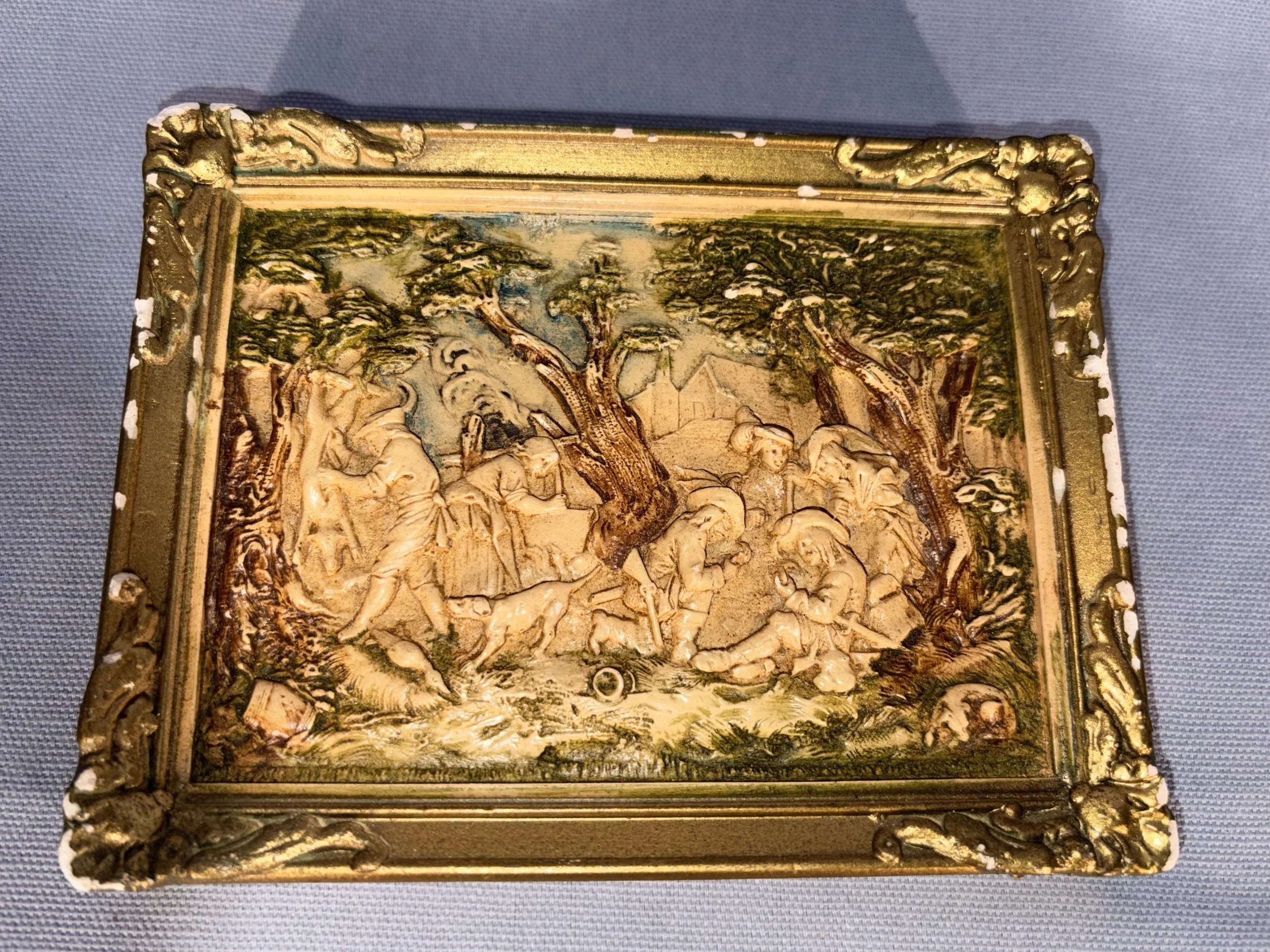
Relief-moulded ceramic tile depicting a lively pastoral genre scene after an 18th-century Rococo or fête galante composition. The scene shows peasants and villagers gathered beneath trees in a wooded landscape, engaged in rural leisure pursuits including bowls or skittles. Figures are rendered in raised relief with expressive movement, typical of historicist decorative wares inspired by works of Watteau, Boucher, and their followers
The tile is finished in polychrome glazes over a buff ceramic body, with muted greens, ochres, and cream tones, and is set within a later ornate gilt-composition frame with scrolling foliate corner ornaments. The modelling and palette suggest manufacture for the decorative rather than architectural market, likely as a wall plaque or cabinet piece.
Such tiles were popular in the late 19th century, particularly in France, Belgium, and Germany, where manufacturers produced relief ceramics inspired by earlier European painting traditions for the bourgeois interior.
Continental Relief-Moulded Ceramic Tile.
Hunting scene.
Probably France or Low Countries, late 19th century.
Relief-moulded ceramic tile depicting a lively pastoral genre scene after an 18th-century Rococo or fête galante composition. The scene shows peasants and villagers gathered beneath trees in a wooded landscape, engaged in rural leisure pursuits including bowls or skittles. Figures are rendered in raised relief with expressive movement, typical of historicist decorative wares inspired by works of Watteau, Boucher, and their followers
The tile is finished in polychrome glazes over a buff ceramic body, with muted greens, ochres, and cream tones, and is set within a later ornate gilt-composition frame with scrolling foliate corner ornaments. The modelling and palette suggest manufacture for the decorative rather than architectural market, likely as a wall plaque or cabinet piece.
Such tiles were popular in the late 19th century, particularly in France, Belgium, and Germany, where manufacturers produced relief ceramics inspired by earlier European painting traditions for the bourgeois interior.