 Image 1 of 1
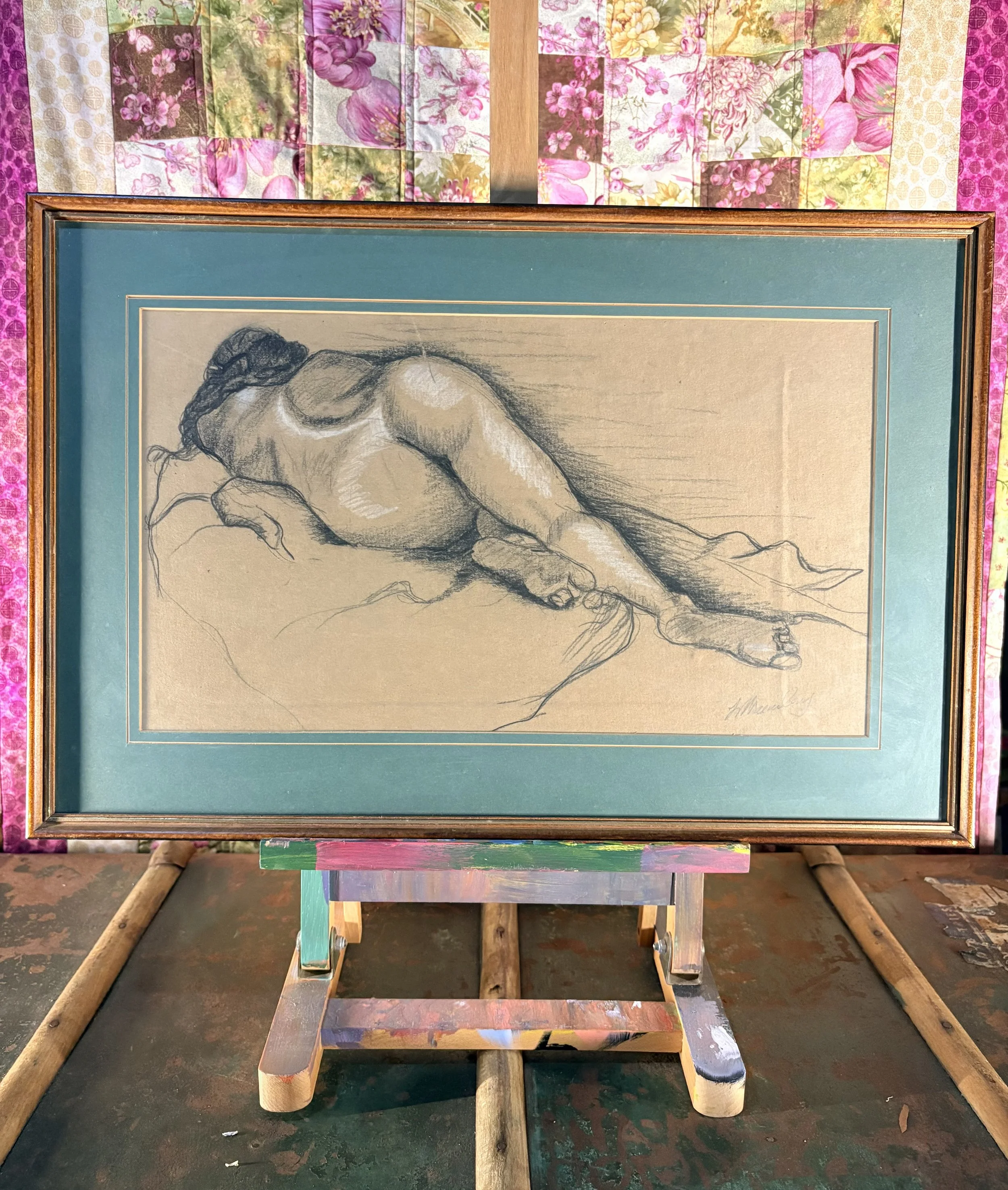
Title: Reclining Female Nude (Studio Study)
Artist: Unknown (in the style of Harry Morley, 1881–1943)
Date: Early–Mid 20th Century (c. 1920–1940)
Medium: Charcoal on toned paper
Dimensions: (insert your sight size / framed size)
Signature: Lower right (indistinct)
Framing: Presented in a later mount with teal mat and gilt wooden frame
Description
A confident and sensitively rendered charcoal study of a reclining female nude, executed on warm-toned drawing paper. The work displays strong academic draughtsmanship, with bold contour lines combined with soft interior modelling, characteristic of early 20th-century British studio practice.
The treatment of the figure—particularly the anatomical solidity of the back, hip, and thigh—closely resembles the life-drawing style of Harry Morley, known for his structurally expressive charcoal studies and classical influences. The cross-hatching, tonal handling, and careful balance of mass and line all suggest a work produced in the milieu of British academic training between the wars.
Title: Reclining Female Nude (Studio Study)
Artist: Unknown (in the style of Harry Morley, 1881–1943)
Date: Early–Mid 20th Century (c. 1920–1940)
Medium: Charcoal on toned paper
Dimensions: (insert your sight size / framed size)
Signature: Lower right (indistinct)
Framing: Presented in a later mount with teal mat and gilt wooden frame
Description
A confident and sensitively rendered charcoal study of a reclining female nude, executed on warm-toned drawing paper. The work displays strong academic draughtsmanship, with bold contour lines combined with soft interior modelling, characteristic of early 20th-century British studio practice.
The treatment of the figure—particularly the anatomical solidity of the back, hip, and thigh—closely resembles the life-drawing style of Harry Morley, known for his structurally expressive charcoal studies and classical influences. The cross-hatching, tonal handling, and careful balance of mass and line all suggest a work produced in the milieu of British academic training between the wars.